
How to show your work when your NDA says no
Most of our work is under NDA. What we publish instead, why we will not use stand-in imagery, and how to tell a led build from a contribution.
Team Quorix Digital
The engineers and strategists who do the work
- trust
- commercials
- writing
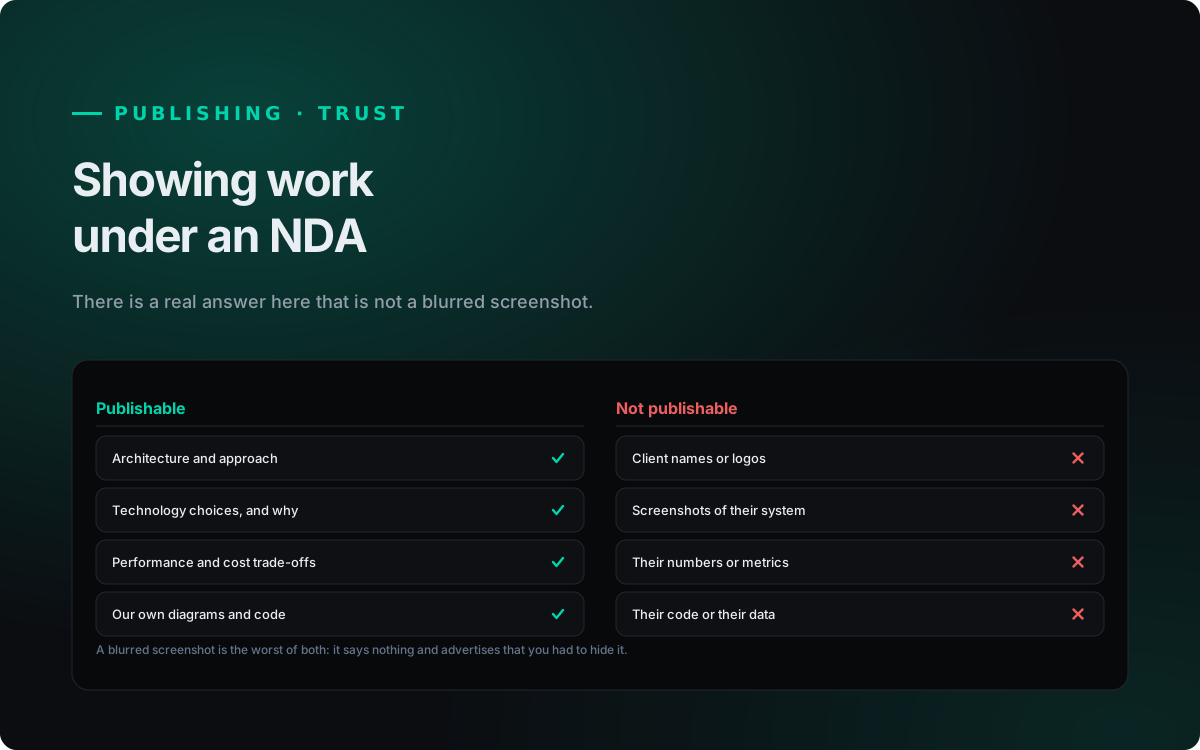
Almost all of our work is under NDA. The agreements stop us naming clients, linking to live systems, and publishing anything that identifies the work or the organisation. So this site has no screenshots, no client logos and no named case studies.
That is an awkward position for a studio, so here is what we do about it and — more usefully — what we decided not to do.
The thing we will not do
There is an obvious workaround. You cannot publish the client's product, so you publish something that looks like it. A stock dashboard, a plausible mobile UI, a generic screenshot with the branding removed. Call it a representative visual.
We tried that internally and it is not survivable.
The job of an image next to a project is to say "this is what we made". A stand-in says the opposite while occupying the space that claim would occupy. That is not a grey area — it is asserting something untrue next to a "we improved conversion by 23%" figure.
Three practical consequences beyond the ethics:
- It gets spotted. Anyone technical recognises synthetic UI in seconds.
- It may breach the same NDA. "Similar to" is doing a lot of work in that sentence. If the client is recognisable — and a distinctive layout often is — you have a confidentiality problem on top of an honesty problem.
- It is the one thing a serious buyer checks. Nobody verifies your architecture claims. Everybody glances at the picture.
So: no stand-in imagery at all. Diagrams we drew, grey-box wireframes, charts of real measured data, screenshots of code we wrote. Nothing else.
What replaced it
We label who led the work. Every project on this site says either "we led this" or "we contributed", and the contributed ones name the part we built and who we built it alongside.
This turned out to be the strongest trust signal on the page. Almost every studio has been on something large; the useful question is which engagements you were accountable for, and answering it unprompted is more convincing than an unqualified claim. Getting it wrong in the optimistic direction is worse than having done less work — a buyer who finds out afterwards that your "delivery we led" was one workstream in someone else's architecture has learned that your claims do not survive contact with detail.
We name the constraint once, in the hero. Not buried in a footnote, and not apologetic. Said once, plainly, it reads as confidence; said never, it reads as evasion.
We describe the problem shape instead of the client. "Cross-platform mobile for a regulated field service" is a recognisable shape. "A logistics company" is not, and naming the sector usually identifies the client anyway.
The gate instead of the link
A public URL proves nothing. What a gated walkthrough on a call proves is considerably more: a client granted access, which means someone trusted us enough to grant it.
If you want to see how something works, that is a conversation. It is also the lowest-friction thing we offer, because a visitor gets to interrogate the system and the decisions in it rather than look at a still image of it.
Where this leaves us
We have fewer real projects on the public site than a studio without NDAs. We are more comfortable with that than with the alternative.
If you are choosing a studio and the one you are talking to has twenty screenshots and no explanation, ask to see the systems on a call. A studio with nothing to show has a reason. A studio showing you representative visuals has a different reason.
If this sounds like your problem
See what we can show you on a call
A public page cannot show you a running system, and a screenshot cannot show you how it behaves under load. On a call we can walk you through something comparable and tell you honestly whether it is comparable to your problem.
No pitch deck. A 30-minute call, and we will tell you if we are the wrong studio for this.
Was this worth your time?
One tap. We read every answer and it changes what we write next.